table of contents
Introduction
You’re sitting outside the interview room. You can hear conversations inside. Every few minutes, another candidate walks out and someone else is called in. Your palms feel slightly sweaty. Your breathing has become a little faster. You suddenly wonder if you’ve forgotten everything you prepared.
If this sounds familiar, you’re not alone. Almost everyone experiences some level of nervousness before an important interview. The good news is that interviewers know this too.
They are not expecting you to behave like someone delivering their hundredth presentation. They understand that interviews are high-stakes situations, particularly for freshers and young professionals.
The objective is not to eliminate nervousness completely. It is to stop it from taking over the way you communicate.
Everyone Feels Nervous Before High-Stakes Conversations
One of the biggest misconceptions about confidence is that confident people don’t feel nervous. In reality, nervousness is a natural response whenever something matters.
Think about people whose jobs involve high-pressure situations.
- A CEO presenting a major business proposal to investors.
- A lawyer making final arguments in court.
- An athlete waiting for the final event of an international competition.
- A surgeon preparing for a complex procedure.
The stakes may be different, but the feeling is often similar. The difference is that experienced professionals learn how to channel that nervous energy into focus instead of letting it control their behaviour.
You can do the same.
The Best Way to Stop Looking Nervous Starts Much Earlier
Don’t forget that the biggest confidence booster isn’t positive thinking, it’s the right amount of preparation.
When you know the role well, understand the company, and have reflected on your own experiences, your brain has far less uncertainty to deal with.
Before the interview, spend time understanding:
- the job description and what the company is looking for,
- the organisation’s products, services and culture,
- examples from your own experiences that demonstrate your strengths,
- why you genuinely want this role.
If you haven’t already done this, our detailed guide on Interview Preparation for Freshers walks you through every step, from researching the company to preparing your answers and body language.
Good preparation doesn’t remove nervousness but it replaces panic with purpose.
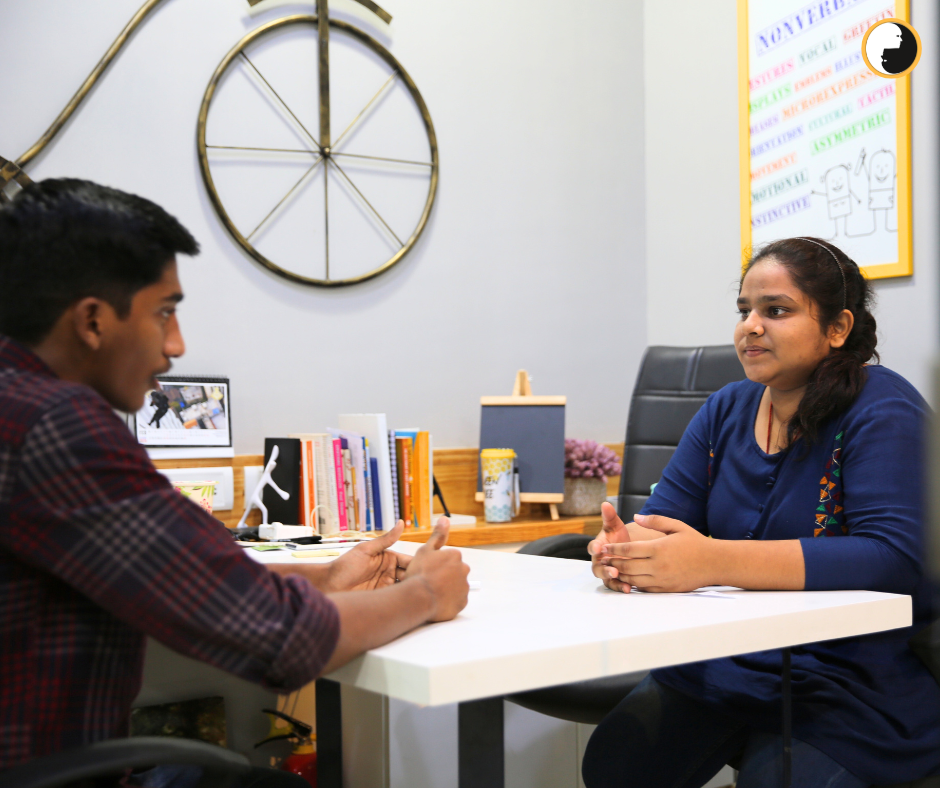
Mock interview preparation for freshers by trainers at Simply Body Talk Academy
Now You’re Outside the Interview Room. What Should You Do?
Let’s come back to the present moment.
The interview is about to begin. This is not the time to revise your resume for the tenth time. Instead, spend the next few minutes changing your mental focus.
Close your eyes for a moment, take one slow breath. Now ask yourself: “Why am I actually a good fit for this role?” The answer should not be because you want the job, but because you have something to offer.
Think about your strengths.
- Perhaps you’re someone who learns quickly.
- Maybe you’ve taken initiative during college projects.
- Perhaps you’ve worked well in teams or handled responsibilities during internships.
Now connect those strengths to the job you’re about to discuss.
If you’ve researched the company, think about how those qualities would help you succeed there. If you don’t remember every detail about the organisation, that’s alright. At the very least, you know the job description.
Think about how your experiences prepare you for that role. This simple exercise shifts your attention away from fear and towards contribution.
Instead of wondering, “What if I fail?”
your mind starts thinking, “Here’s what I can bring.”
That change alone often reduces visible nervousness.
Stop Trying to Look Perfect
Many candidates become nervous because they are trying not to make mistakes. Ironically, that pressure often creates even more mistakes.
Remember that interviewers are evaluating your overall potential. If you pause briefly before answering a difficult question, that doesn’t automatically make you look nervous. In fact, taking a moment to think often appears more thoughtful than rushing into an answer.
Likewise, if you don’t know one answer, acknowledge it honestly and move forward. One difficult question rarely decides the outcome of an interview.
Let Your Body Help Your Mind
When people feel nervous, they often focus entirely on their thoughts. Your body, however, can also influence how you feel.
Before entering the room:
- Instead of pacing rapidly, stand comfortably for a few moments.
- Instead of constantly checking your phone, look around and become aware of your surroundings.
- Allow your breathing to slow naturally.
- When your name is called, avoid rushing into the room.
- Walk at your normal pace.
These small behaviours signal to your brain that the situation is manageable.
Remember That the Interview Is a Conversation
It’s easy to think the interviewer is trying to catch you out. Most interviewers are actually trying to understand whether you would work well with their team.
- Listen carefully.
- Respond to the question that has been asked rather than the one you expected.
- If you need clarification, it’s perfectly acceptable to ask.
Good communication is often more valuable than delivering memorised answers.
One Last Reminder Before You Walk In
Just before the interview begins, remind yourself of three things:
- You know more about yourself than anyone else in the room.
- You have experiences that prepared you for this opportunity.
- The interviewer already expects you to be a little nervous.
You don’t have to prove that you’re fearless. You simply have to help the interviewer see your potential.
How Simply Body Talk Academy Can Help
At Simply Body Talk Academy, we believe interview success comes from much more than preparing answers. Through our interview preparation program, we help students and young professionals understand how to present their experiences with confidence, communicate authentically, and manage visible nervousness during high-pressure situations.
If you’re looking for structured guidance, mock interview practice, and practical feedback on both your communication and body language, our programs are designed to help you approach interviews with greater clarity and confidence.
If you are a trainer working with students and young professionals, you’ve probably noticed that interview success comes from helping participants develop the right mindset, learn body language techniques, understand their own strengths, practise answering questions in different situations, receive constructive feedback, and become comfortable communicating under pressure. By the time they walk into the interview room, they shouldn’t be wondering what to say – they should already know how to think.
That is why, Simply Body Talk Academy’s Interview Course curriculum goes beyond common interview questions and body language tips. Our trainer certification equips trainers with a structured methodology, practical activities, mock interview frameworks, and ready-to-deliver session plans that help participants build confidence through repeated practice rather than last-minute advice.
If you’re looking to conduct impactful interview preparation programs, our ready-made curriculum can help you prepare students more thoroughly and increase their chances of performing well in interviews.